Gerald Thompson Mapoe | Founder, OERC Advisory | Operational English Risk Communication Specialist
What does one undefined word actually cost a logistics operation?
More than most organisations ever measure, and far more than most ever connect back to communication.
In logistics, organisations measure almost everything that moves the operation:
- Transit times
- Freight rates
- Fuel costs
- Storage
- Demurrage
- Detention
- Service levels
- On-time performance
- Operational costs
What is rarely measured directly is the cost created when people understand the same instruction differently.
Consider a word used thousands of times across the industry: “Ready.”
For a freight forwarder, ready may mean that the shipment has been packed and the documentation is complete. A warehouse may interpret it as cargo received and prepared. A transporter may understand it to mean physically available for collection. A customer may assume it means the shipment is already cleared and ready to move.
Everyone speaks the same language. Everyone believes the instruction is clear. Yet four different parties may be preparing for four different operational outcomes.
| Shared language does not guarantee shared meaning. That gap is where communication risk begins. |
The communication failure rarely appears on the invoice
Imagine a transporter receives an instruction at 09:00: “Cargo is ready for collection.”
The transporter dispatches a vehicle. The driver arrives at 11:00. But the cargo is not actually available. Documentation may still be outstanding, customs release may not have been completed, or the warehouse may still be waiting for confirmation from another party.
The vehicle waits. The collection is rescheduled. Another transport slot has to be arranged. Operations becomes involved, and customer service begins managing the escalation.
What started as a two-line communication now involves multiple people, multiple departments, and additional operational costs:
- Truck waiting time
- Driver overtime
- Additional handling
- Storage
- Rebooking
- Administrative rework
Those costs may appear under several different categories, but the original communication failure may never appear as a cost category. There is no invoice line saying, “Undefined operational language.” The cost is visible. The cause is often hidden.
What could that ambiguity cost? The following is a purely illustrative scenario. A failed collection resulting from an ambiguous “ready” instruction creates:
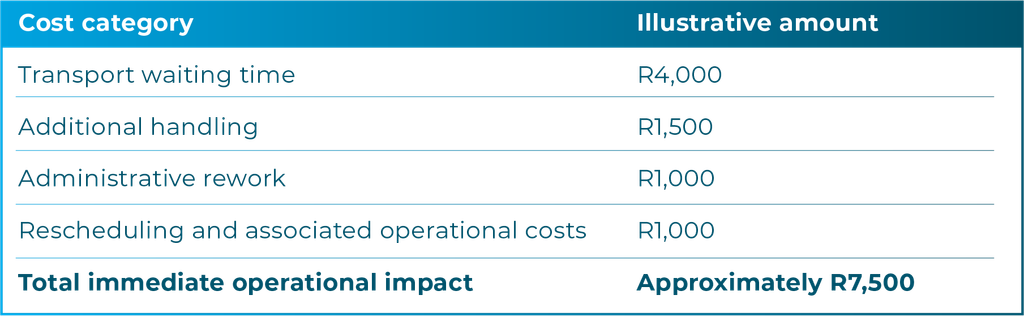
One incident may be manageable. But if a similar communication failure occurs just four times a week, the illustrative exposure becomes approximately R30,000 per week—approximately R120,000 per month, or potentially R1.44 million per year.
These figures are illustrative, not an industry benchmark. They simply show how relatively small operational costs can accumulate when the underlying ambiguity is repeated.
Even that calculation excludes harder-to-measure consequences:
- Lost capacity
- Management time
- Customer dissatisfaction
- Service-level deterioration
- Internal escalation
- Reputational damage and potential loss of future business
Does your organisation actually know how much operational ambiguity is costing the business?
The problem is not poor English
This distinction matters. Many logistics professionals communicating across international supply chains are highly competent English speakers. The problem is often not grammar. It is precision.
Consider the instruction: “Please check the customs documents.”
What does check mean? Review them? Correct them? Submit them? Confirm they are complete? Send them to customs? And by when?
Now consider the more precise version: “Please submit the completed customs clearance documents to the appointed customs agent by 14:00 today and confirm completion by email.”
The second instruction defines the action, the expected outcome, the deadline, and the confirmation requirement. The difference is not better English. It is better operational definition.
From activities to outcomes
This is where organisations can begin reducing communication risk. Many operational instructions describe an activity without defining the required outcome.
Common examples include:
- “Check.”
- “Follow up.”
- “Handle.”
- “Confirm.”
- “Send.”
- “Urgent.”
- “Ready.”
These words are not inherently wrong. The problem occurs when different parties attach different operational meanings to them.
A stronger communication framework asks five questions:
- Who is responsible?
- What exactly must happen?
- What is the deadline?
- What constitutes completion?
- How will completion be confirmed?
| One Clear Sentence. One Deadline. One Owner. Zero Assumptions. |
Why this matters to executives
Communication is often treated as a soft skill. In logistics, however, it sits inside the operational process.

The communication itself may take 20 seconds. The operational consequence can continue for days.
That is why organisations should ask two separate questions:
- “Are our employees communicating professionally?”
- “Are our operational instructions precise enough to produce the outcome we expect?”
Those are very different questions.
Communication risk can be managed
This does not mean creating endless procedures or turning every email into a legal document. It means identifying where communication creates operational exposure.
Key areas include:
- Freight handovers — Are key status terms consistently understood?
- Documentation — Do teams know exactly what “complete” means?
- Escalations — Does “urgent” have a defined operational response?
- Transport — Does “ready for collection” mean physically available?
- Customer communication — Are commitments clearly separated from acknowledgements?
- Cross-border operations — Are terminology and expectations consistent across countries, cultures, and organisations?
These are not merely communication questions. They are operational risk questions.
This is where OERC Advisory comes in
OERC Advisory approaches communication through an operational risk lens. The objective is not simply to improve someone’s English. It is to identify where language and communication create friction within the logistics process.
This can involve examining:
- Handover points
- Operational instructions
- Documentation processes
- Escalations
- Terminology
- Ownership
- Confirmation practices
Sessions are built around real operational scenarios from within the organisation itself. The operation becomes the material.
From there, organisations can identify recurring ambiguity, establish clearer operational definitions, implement communication standards, and review whether those changes are improving execution.
The goal is simple:
- Less assumption
- Less friction
- Less avoidable rework
- More predictable execution
The executive question
Every organisation measures the financial consequences of operational failure. But perhaps we should also look further upstream—before the consequence becomes visible.
- Before the truck was delayed.
- Before the vessel was missed.
- Before the documentation had to be corrected.
- Before the customer escalated.
- Before the additional cost appeared.
What was communicated? More importantly, what did the person receiving that communication think it meant?
Sometimes the most expensive part of a logistics operation is not the mistake itself. It is the assumption that everyone understood the instruction in exactly the same way.
In logistics, the most expensive English is not wrong English.
It is undefined English.
About OERC Advisory
Gerald Thompson Mapoe is the Founder of OERC Advisory, a specialist consultancy helping logistics and freight-forwarding organisations reduce operational friction by addressing communication gaps that can contribute to delays, liability exposure, and financial loss.
OERC Advisory focuses on the operational language and communication points that create disproportionate risk across handovers, documentation, escalation, and multi-party coordination.
Warmly,
Gerald Thompson Mapoe
Founder, OERC Advisory | Operational English Risk Communication Specialist